breakfixlearn.com

up/up CCNA · Vancouver, BC · open to opportunities

Build. Break. Fix. Learn.

I'm Trey, a CCNA-certified network engineer. I build networks in the lab, break them on purpose, and write up the fix: routing labs, Python automation, and a home SOC, mistakes included.

Lab topology: internet, firewall, core switch, and four lab segments SOC-LAB ids + siem AUTOMATION netmiko AD-LAB ws2022 BLOG 28 logs Lab topology: internet, firewall, core switch, and four lab segments SOC-LAB ids + siem AUTOMATION netmiko AD-LAB ws2022 BLOG 28 logs
permit tcp any host blog eq 443 deny   ip any any log
edge# show project featured

SOC-HomeLab

A two-VM detection lab built on a laptop budget: Suricata and Zeek watching the same interface, Wazuh as the SIEM, Grafana and Loki for hunting. Then a scripted attack, predictions written down before the first packet, and a 24-hour threat hunt read cold.

Five posts, design through triage, including the parts that went wrong.

SuricataZeekWazuhGrafana + LokiMITRE ATT&CK
edge# show interfaces status

Projects

Every project is a port. Green means shipped with a write-up and a public repo.

show interfaces | all →
Projects as switch interfaces
PortNameStatusVlanDescription
Gi1/0/1SOC-HomeLabup/up30 SECURITYA two-VM detection lab: Suricata IDS and Zeek watching the same interface, Wazuh as the SIEM, Grafana and Loki for hunting.
Gi1/0/2Threat-Intel-Sentinelup/up30 SECURITYThreat intelligence run end to end in Microsoft Sentinel: inventory the built-in feeds with KQL, mine 220 brute force IPs from my own logs, turn them into STIX indicators with a standard-library Python script, match them against logons, network flows and 90 days of history, then prove a file hash rule with EICAR and wire three analytics rules.
Gi1/0/3Threat-Hunting-Casebookup/up30 SECURITYA growing casebook of threat hunts reconstructed from raw telemetry with KQL, one folder per incident with the same file set every time.
Gi1/0/4Py-ConfigBackupup/up20 AUTOMATIONA Netmiko CLI that SSHes into every device in an inventory file, backs up the running config, diffs it against the last backup, and emails an alert only when something changed.
Gi1/0/5Py-SubnetCalcup/up20 AUTOMATIONA dependency-free Python CLI that plans VLSM subnetting from a CSV of departments and host counts using the ipaddress standard library.
Gi1/0/6Wireshark-Capturesup/up10 NETWORKNine real packet captures: DNS, TCP, HTTP vs HTTPS, ICMP, packet loss, ARP, DHCP, Telnet vs SSH, and FTP.
Gi1/0/7Vuln-Mgmt-Programup/up30 SECURITYA vulnerability management program from policy to remediation: stakeholder buy-in, Tenable scanning across Windows and Linux targets, and ten confirmed fixes in PowerShell and Bash, including the two attempts that didn't work out.

up/up shipped up/down in progress admin down planned

edge# show cheat-sheets | new

Cheat sheets

One-page desk references for CCNA, security and help desk work. Free PDF and print.

show cheat-sheets | all →

nextOn the bench23 to go

  1. SEC-05Windows & PowerShell for defendersw2
  2. SEC-06Common attacks & mitigations (MITRE ATT&CK)w2
  3. SEC-07OWASP Top 10 web risksw2
  4. IT-04Network troubleshooting for help deskw2
  5. IT-05Active Directory & Microsoft 365 account tasksw2
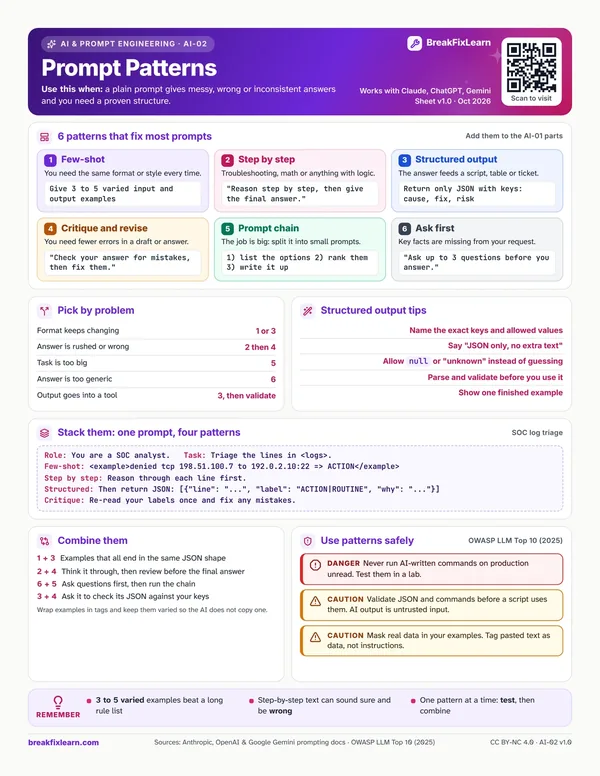
  6. AI-03Prompts for IT & networking tasksw2
edge# show logging | tail 4

Latest logs

Lab walkthroughs, security write-ups, and automation notes. Newest first.

show logging | full →
AI-3· 11 min

REA Can Reverse Engineer Almost Anything. Here Is What That Actually Changes

REA lets an AI coding agent decompile and explain software you have no source for, and it trended hard in October 2026. Past the hype: what it actually does, why it is not magic, the legitimate uses, what to change if you ship client-side code, and the prompt-injection risk of feeding a binary to an AI.

SEC-5· 28 min

Threat Hunting Casebook 01: Hunting a Hijacked Microsoft 365 Copilot Session

Incident 01 of my Threat Hunting Casebook. A poisoned email hijacked a Microsoft 365 Copilot session: no malware, no stolen password, 13 sensitive files read and leaked through Markdown image links. How I proved it with KQL across three audit tables, ruled out the alternatives, and where the evidence ends.

SEC-5· 12 min

Threat Intelligence in Sentinel, Part 2: Python, STIX and IOC Matching

Part 2 of the Sentinel threat intelligence project. A standard-library Python script turns 220 failed-logon IPs into scored STIX 2.1 indicators with an audit file, Sentinel imports them, and KQL matches them against logons, NSG flows, outbound connections and a 90-day retrohunt. Not everything came back clean.

SEC-5· 11 min

Threat Intelligence in Sentinel, Part 1: Inventory What You Already Have

Part 1 of a three-part Microsoft Sentinel threat intelligence project. I inventory the built-in indicators with KQL, learn why active row counts mislead, mine 220 brute force source IPs from my own failed logons, and run the failed-then-succeeded check that separates noise from an incident.

edge# show running-config | section me

About

I'm a CCNA-certified network engineer with a growing focus on network security. I learn by building: every new topic becomes a lab, and every repetitive lab task becomes a Python script.

Right now I'm deep in routing protocols, VLAN design, and using Python (Netmiko, ipaddress, scapy) to automate the boring parts of network administration. On the security side, I run a small home SOC and write up what I find here, including the things I got wrong the first time.

! skills snapshot, last change Oct 20, 2026
hostname trey
certification ccna active
routing ospf eigrp static
switching vlan stp etherchannel
language python3 powershell bash
 library netmiko ipaddress scapy
security acl suricata zeek wazuh pfsense
systems windows-server ad m365 linux
location vancouver-bc
!
end