Security fundamentals & key terms
Use this when: you start in security or help desk and need the core ideas, and the words analysts use, in one place.
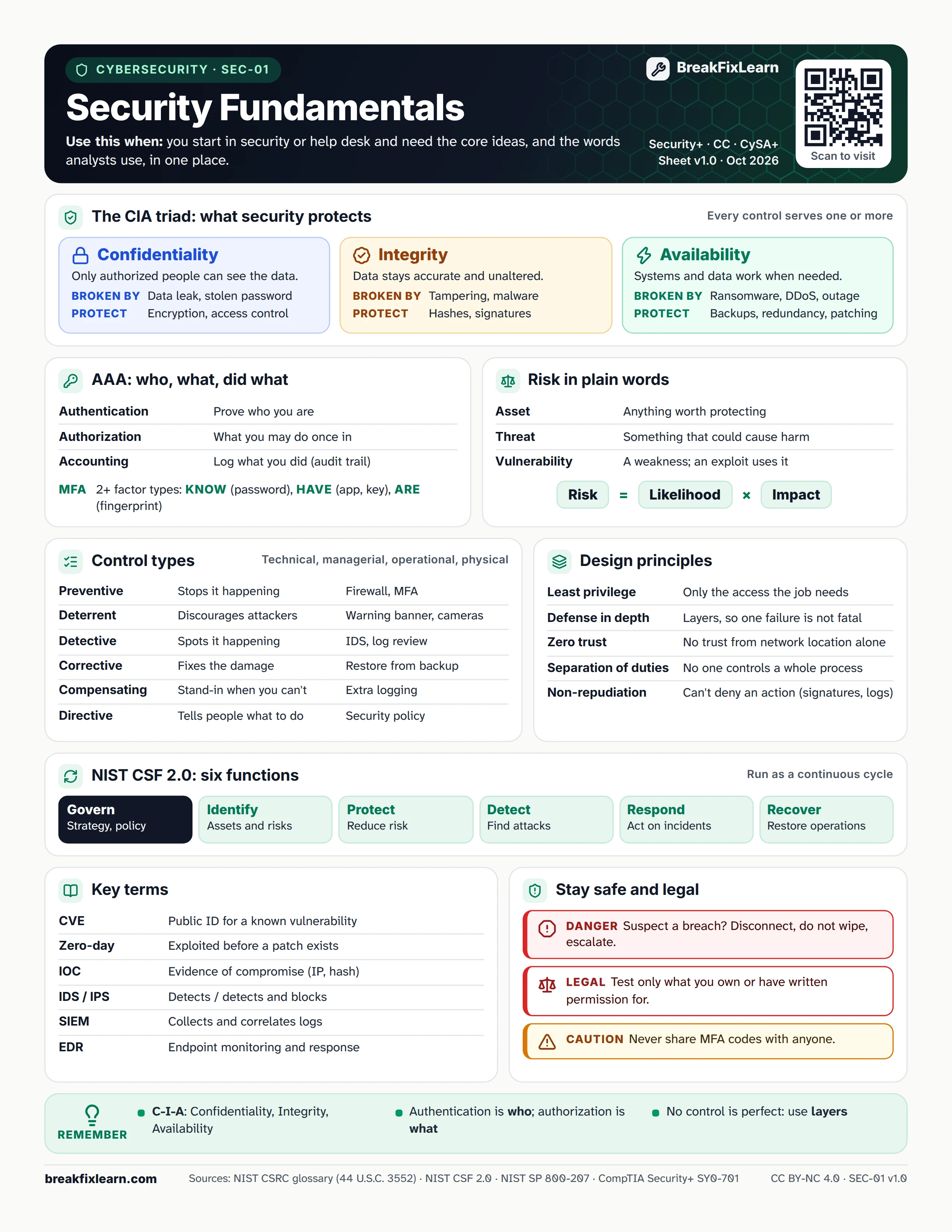
Text version
Everything on the sheet, as plain HTML: handy for screen readers, copy-paste and search.
The CIA triad
Every security control serves one or more of these three goals.
| Goal | Meaning | Broken by | Protect with |
|---|---|---|---|
| Confidentiality | Only authorized people can see the data | Data leak, stolen password | Encryption, access control |
| Integrity | Data stays accurate and unaltered | Tampering, malware | Hashes, signatures |
| Availability | Systems and data work when needed | Ransomware, DDoS, outage | Backups, redundancy, patching |
AAA: who, what, did what
| Term | Meaning |
|---|---|
| Authentication | Prove who you are |
| Authorization | What you may do once in |
| Accounting | Log what you did (audit trail) |
Multi-factor authentication (MFA) uses two or more factor types: something you know (password), something you have (app, key) and something you are (fingerprint).
Risk in plain words
| Term | Meaning |
|---|---|
| Asset | Anything worth protecting |
| Threat | Something that could cause harm |
| Vulnerability | A weakness; an exploit uses it |
Risk = likelihood × impact.
Control types
Categories: technical, managerial, operational and physical.
| Type | Does what | Example |
|---|---|---|
| Preventive | Stops it happening | Firewall, MFA |
| Deterrent | Discourages attackers | Warning banner, cameras |
| Detective | Spots it happening | IDS, log review |
| Corrective | Fixes the damage | Restore from backup |
| Compensating | Stand-in when you can't use the usual control | Extra logging |
| Directive | Tells people what to do | Security policy |
Design principles
| Principle | Meaning |
|---|---|
| Least privilege | Only the access the job needs |
| Defense in depth | Layers, so one failure is not fatal |
| Zero trust | No trust from network location alone |
| Separation of duties | No one controls a whole process |
| Non-repudiation | Can't deny an action (signatures, logs) |
NIST CSF 2.0: six functions
| Function | Meaning |
|---|---|
| Govern | Strategy, policy and roles |
| Identify | Know your assets and risks |
| Protect | Safeguards that reduce risk |
| Detect | Find attacks and compromises |
| Respond | Act on an incident |
| Recover | Restore operations |
Key terms
| Term | Meaning |
|---|---|
| CVE | Public ID for a known vulnerability |
| Zero-day | Exploited before a patch exists |
| IOC | Evidence of compromise (IP, hash) |
| IDS / IPS | Detects / detects and blocks |
| SIEM | Collects and correlates logs |
| EDR | Endpoint monitoring and response |
Stay safe and legal
Danger. Suspect a breach? Disconnect, do not wipe, and escalate to security.
Authorized use only. Test only what you own or have written permission for.
Caution. Never share MFA codes with anyone.
Remember
- C-I-A: Confidentiality, Integrity, Availability
- Authentication is who; authorization is what
- No control is perfect: use layers
Sources
- NIST CSRC glossary, information security
- NIST Cybersecurity Framework 2.0 (CSWP 29)
- NIST SP 800-207, zero trust architecture
- CompTIA Security+ certification objectives